Seawater systems operate under some of the harshest conditions any piping infrastructure faces. High chloride concentrations, constant moisture, and aggressive marine organisms degrade ordinary metals within months. Engineers managing desalination plants, offshore platforms, and naval vessels need components that hold up for decades. Cupro Nickel Fittings have become the material of choice across marine applications because they resist seawater corrosion, suppress biofouling, and maintain mechanical integrity across long service cycles. Where stainless steel pits and carbon steel rust, Copper Nickel Fittings continue to perform.
What Are Cupro Nickel Fittings?
Cupro Nickel or Copper-Nickel alloy is an alloy of copper and nickel in two compositions suitable for marine use. The 90/10 grade is suitable for general seawater piping with moderate flow velocities. The 70/30 grade has improved strength and corrosion resistance for high velocity or high pressure service. Both grades carry iron and manganese additions that reinforce resistance to erosion and impingement attack.
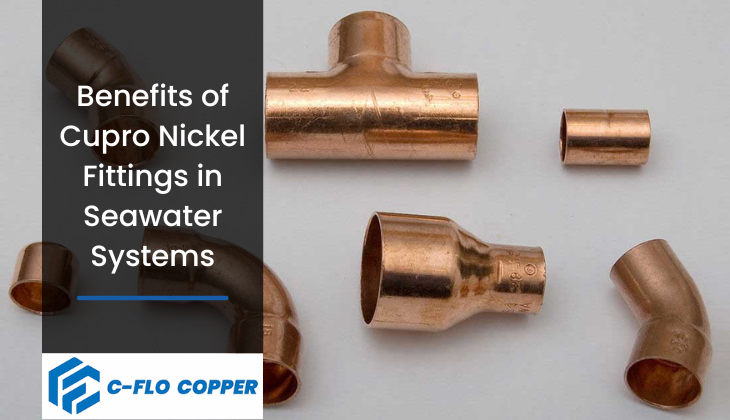
Cupro Nickel Pipe Fittings come in five standard configurations. Elbows redirect flow at 45° or 90°. Tees split or merge flow streams. Reducers transition between pipe diameters. Couplings join straight pipe sections, and caps terminate open pipe ends. Each type plays a defined role in seawater piping systems built to last 25 years or more.
Why Seawater Systems Require Specialized Fittings
Seawater contains roughly 35,000 mg/L of dissolved salts, with chloride concentrations near 19,000 mg/L. That chloride load attacks standard metals at the microscopic level, triggering pitting corrosion at weld seams and crevices. Barnacles, mussels, algae, and microbial films also colonize pipe interiors, reducing flow capacity and accelerating under-deposit corrosion. Carbon steel fittings degrade within 18 to 36 months in full seawater immersion. Even austenitic stainless steel grades fail through crevice corrosion when seawater stagnates inside joints. Components built from alloys with inherent marine resistance eliminate these failure modes and cut the maintenance burden that offshore operators spend millions managing each year.
Key Benefits of Cupro Nickel Fittings in Seawater Systems
Cu-Ni Fittings deliver a combination of properties that no single alternative alloy fully replicates. Six performance advantages explain why marine engineers specify them above all other options.
Exceptional Corrosion Resistance
Copper-Nickel alloys form a stable cuprous oxide film on contact with seawater that rebuilds itself rapidly if scratched. Cu-Ni fittings resist pitting and crevice corrosion at weld joints and flange faces. The 70/30 grade can withstand seawater velocities up to 3.5 m/s without erosion-corrosion, while 90/10 performs reliably up to 3.0 m/s. Both grades retain their protective oxide layer over the water temperature range from near freezing to 80°C, which includes the operating range of coastal desalination and power station cooling circuits.
Natural Resistance to Biofouling
Marine organisms avoid colonizing cupronickel surfaces. Copper ions released from the alloy surface are toxic to barnacles, mussels, algae, and biofilm-forming bacteria, keeping pipe interiors clear without chemical dosing. Offshore platforms running cooling water circuits through Cu-Ni Fittings report biofilm formation rates 70 to 80% lower than identical carbon steel circuits. Clean internal surfaces maintain the designed flow capacity throughout service life, cutting the frequency and cost of pipe cleaning campaigns considerably.
Long Service Life
Copper Nickel Pipe Fittings installed in seawater systems routinely last 30 to 40 years with no structural degradation. Naval architects have tracked Cu-Ni piping on vessels commissioned in the 1980s still in service today, wall thickness intact. A shipboard cooling system using Cu-Ni Fittings requires fitting replacement only during major dry-dock overhauls every 10 to 15 years, versus annual or biennial cycles for inferior alloys in the same seawater environment.
High Strength and Durability
The 70/30 Cu-Ni grade achieves a tensile strength of 380 to 450 MPa and a yield strength of 170 MPa. Cupro Nickel Pipe Fittings handle pressure ratings up to 150 bar in standard wall configurations. They tolerate thermal cycling without cracking at weld toes or flange faces. When a fitting must carry both pressure and mechanical load simultaneously, as in offshore riser systems subject to wave-induced vibration, Copper Nickel performs where softer alloys deform.
Excellent Fabrication and Weldability
Cu-Ni Fittings weld cleanly with TIG, MIG and shielded metal arc processes with little preheat. Cupro Nickel Pipe Fittings thread, bend and machine without the work-hardening problems that plague other copper alloys. A cupronickel fittings manufacturer that has in-house forming capability can supply custom elbows and reducers to project specs faster than suppliers that rely only on casting. This is critical in offshore construction schedules where installation complexity directly impacts the commissioning schedule.
Low Maintenance Requirements
Copper Nickel Fittings need minimal attention once installed. No cathodic protection anodes are necessary, unlike carbon steel systems that need sacrificial anodes replaced every two to three years. No internal pipe coating is required, eliminating delamination risk. External inspection intervals stretch to five years under most offshore regulatory frameworks. Reduced maintenance hours translate directly into lower operating expenditure, a measurable saving when offshore labor costs.
Common Applications of Copper Nickel Fittings in Seawater Systems
Marine Vessels
Naval and commercial vessels run seawater cooling circuits continuously through their engine rooms. Cu-Ni Fitting networks handle jacket water cooler circuits, lube oil coolers, and air compressor intercoolers operating at seawater velocities between 1.5 and 3.0 m/s.
Offshore Oil and Gas Platforms
Offshore platforms use seawater for firewater deluge systems, utility water supply and process cooling. Copper Nickel Fittings are a reliable option for these circuits in topside and subsea designs where maintenance access is restricted and the effects of failure are serious.
Desalination Plants
Multi-stage flash and reverse osmosis desalination plants pump large volumes of raw seawater through pre-treatment and heat recovery circuits. Cu-Ni Fittings handle aggressive feedwater chemistry without pitting or scaling that would compromise membrane or evaporator performance.
Coastal Power Stations
Thermal power stations on coastlines draw seawater for condenser cooling. Cupro Nickel Pipe Fittings route this water through intake, distribution, and discharge circuits where chloride concentrations and biological content would rapidly destroy carbon steel alternatives.
Shipbuilding Industry
New-build shipyards specify Cu-Ni piping packages for seawater ballast, bilge, and fire suppression systems. A Copper Nickel Fitting installed at the build stage runs through the full 25-year design life of the vessel without replacement.
Firewater and Cooling Water Systems
Firewater and open-cycle cooling systems cycle seawater through dozens of fittings and headers. Cu-Ni Fittings maintain joint integrity through pressure surges during demand events, including fire suppression activations where pressure can spike above 12 bar within seconds.
Factors to Consider When Choosing a Cu-Ni Fitting
Selecting the right Cupro Nickel Pipe Fitting involves six key variables. Operating temperature determines whether a 90/10 or a 70/30 alloy suits the service. Pressure requirements set the minimum wall thickness. Seawater velocity governs which grade avoids erosion-corrosion at the system’s flow rates. Project budget influences whether 70/30 is justified or whether 90/10 covers the specification. Environmental conditions such as polluted harbour water with elevated sulphide content may require 70/30 regardless of other factors. Compliance with ASTM B466 and ASTM B467 confirms the fitting meets recognized benchmarks for seawater service.
Conclusion
Copper Nickel Fittings provide the ideal blend of chloride corrosion resistance, natural biofouling resistance, and mechanical strength in one alloy that surpasses the performance of carbon steel and stainless steel in seawater environments. The self-renewing oxide film, copper ion release and pressure-rated strength of inferior fittings address the three failure modes that prematurely end their service life. Project engineers specifying long-life seawater infrastructure will benefit from choosing a trusted cupronickel fittings manufacturer such as C-Flo Copper. The company’s ISO-certified process includes a six-step quality check before dispatch, ensuring every fitting shipped meets the metallurgical and dimensional standards the job requires.
Frequently Asked Questions (FAQs)
Why are Cupro Nickel fittings used in seawater systems?
Cu-Ni Fittings form a protective oxide layer in seawater which prevents chloride induced corrosion. Copper content also prevents bio-fouling and keeps pipe circuits clean without chemical treatment.
What is the difference between 90/10 and 70/30 copper-nickel fittings?
The 70/30 grade has a 30% Ni content which gives a tensile strength of more than 380 MPa and a seawater velocity tolerance of 3.5 m/s. The 90/10 grade is suitable for moderate flow conditions at a lower material cost.
Are Cu-Ni fittings resistant to marine biofouling?
Copper ions released from the alloy surface inhibit barnacle and algae settlement. Cu-Ni circuits report biofouling accumulation rates 70 to 80% lower than carbon steel pipe networks in identical seawater environments.
What industries commonly use Cupro Nickel Pipe Fittings?
Shipbuilding, offshore oil and gas, coastal power generation, and desalination plants all specify Copper Nickel Pipe Fittings as the standard for seawater piping circuits requiring long service intervals.
How long do Copper Nickel fittings last in seawater environments?
Naval vessels commissioned in the 1980s with piping systems still intact today demonstrate that Cu-Ni Fittings routinely provide 30 to 40 years of service in full seawater immersion, as shown in operational records.
By C-Flo Copper | June 25, 2026